















15 Zendesk Alternatives That Are Actually Cheaper (Pricing Verified, 2026)

Shalin
Founder & CEO HappyFox
May 12, 2026
The best Zendesk alternatives in 2026 are Freshdesk (best for SMBs, from $19/agent/month), HappyFox (best for mid-market teams, unlimited agents at $1,999/month with AI at $14/agent/month and no per-resolution fees), Gorgias (best for e-commerce), Help Scout (best for inbox simplicity), Intercom (best for AI-first support), Zoho Desk (best budget option), and Salesforce Service Cloud (best for enterprise). All pricing verified May 2026.
If you are evaluating Zendesk alternatives, you have likely already seen the renewal number. The base seat cost went up. The AI add-on appeared as a separate line item. Below that, per-resolution charges for every ticket the system handled automatically.
Zendesk Suite plans start at $55/agent/month and reach $115/agent/month for Suite Professional. The Advanced AI package adds $50/agent/month on top, and each AI-resolved ticket carries a further $1.50 to $2.00 charge.
Zendesk holds a 4.3/5 rating across 6,825 verified reviews on G2, with 92% of reviewers giving it 4 or 5 stars. The dissatisfaction that drives switching is narrower: per-agent pricing that compounds as teams grow, and AI features locked behind plan upgrades that push existing customers onto more expensive tiers.
The pattern shows up consistently across community discussions.
"Our Zendesk bill has climbed to around $5,000 per month, not including add-ons. Switching could potentially save us tens of thousands of dollars annually."
— r/Zendesk, "Zendesk is becoming too expensive for our company"

"Zendesk costs shot up, now it's eating budget for basic tickets and chat. Not sure which holds up for real support without constant upsells."
— r/SaaS, "Zendesk pricing jumped again, what alternatives actually work without the hassle?"

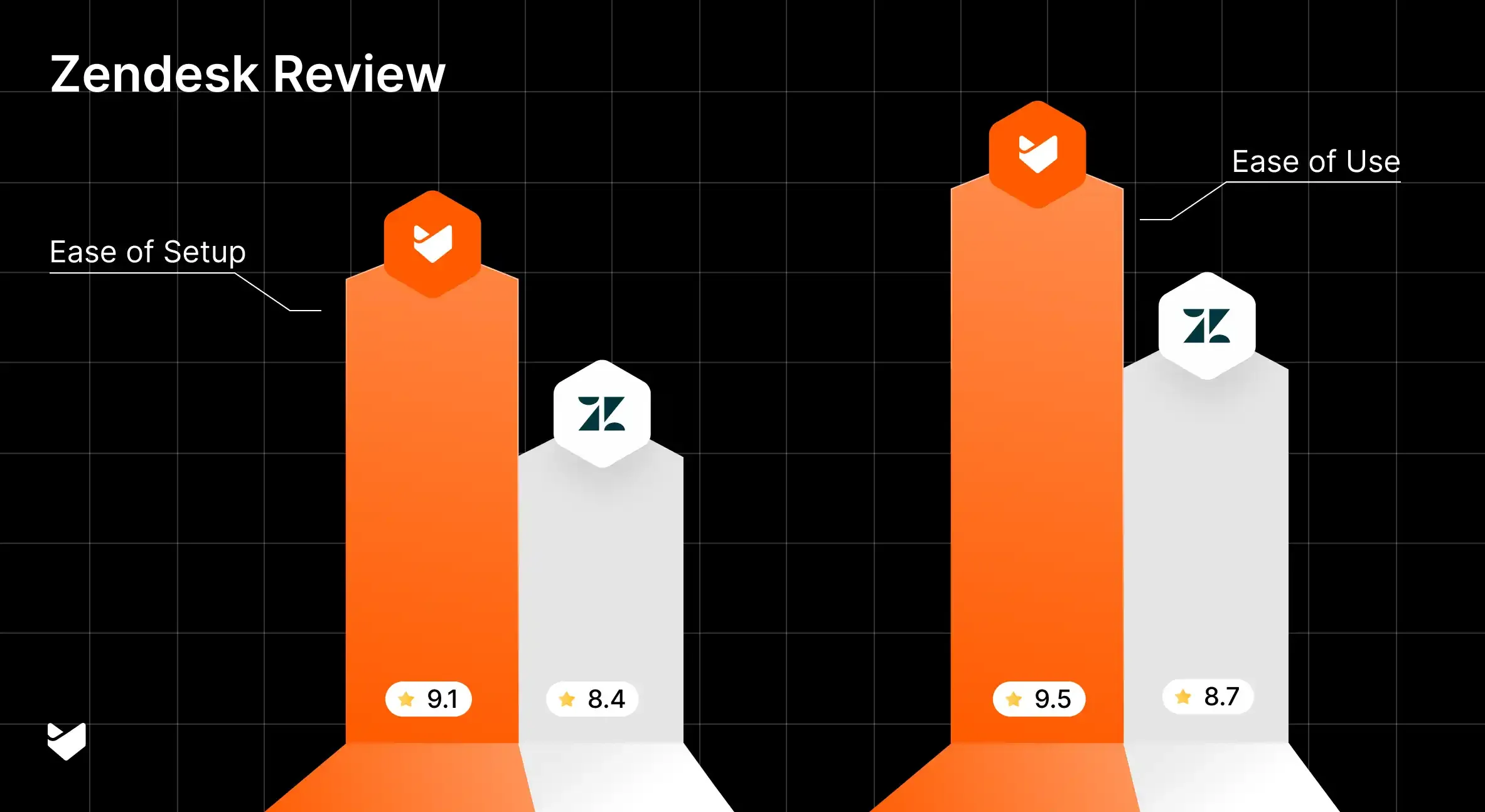
Setup adds to the friction. Standard Zendesk deployments run 4 to 8 weeks and commonly require certified third-party partners. Several alternatives in this guide score between 9.1 and 9.4 on G2 ease of use, with setup measured in hours.
This guide compares all 15 on verified pricing, AI costs, G2 scores, and setup time.
This guide compares 15 Zendesk alternatives across pricing, AI costs, setup time, and fit - using verified data so the decision can be based on facts rather than vendor claims.
- Cost at 20, 50, and 100 agents across the top 4 platforms
- Zendesk's full AI cost: $50/agent/month add-on plus $1.50–$2.00 per AI-resolved ticket
- The only platform with unlimited-agent pricing - and the threshold where it becomes cheaper
- G2 ease-of-use scores across all 15 tools
- Setup time from signup to first live ticket for each platform
Find your shortlist in 30 seconds:
- Per-agent costs too high at 40+ agents → HappyFox unlimited-agent plan
- AI add-on costs unpredictable → HappyFox ($14/agent/mo flat vs. Zendesk's $50 + per-resolution fees)
- Setup takes weeks, not days → HappyFox, Freshdesk, Help Scout
- Need CS + IT/HR on one platform → HappyFox
- Deep Salesforce CRM integration → Salesforce Service Cloud
- Inbox simplicity for teams under 15 agents → Help Scout, Hiver
- IT/ITSM with ITIL compliance → Jira Service Management, Freshservice
- Budget is zero → Spiceworks (IT only) or Freshdesk (free tier)
Best Zendesk Alternative by Use Case (2026)
The right Zendesk alternative depends almost entirely on why you are switching and what your team looks like. Use the routing logic below to reach your shortlist in one step before reading 15 full profiles.
-
Start here - match your situation to the right category:
- Costs too high at 30+ agents → Mid-market predictable pricing section
- Need CS + IT/HR ticketing on one platform → Mid-market predictable pricing section
- Small team, fast setup, low budget → SMB and early-stage teams section
- Large enterprise, Salesforce-dependent → Enterprise section
- IT department, ITIL compliance → IT helpdesks section
- Zero budget → IT helpdesks section (Spiceworks)
Best for SMB and Early-Stage Teams (under 30 agents)
-
Freshdesk:
G2: 9.1/10 , Setup: 1–3 days , From: free / $15/agent/month
Closest Zendesk feature-parallel at a lower price. Free tier available. AI is session-based (500 free, then $49/100 sessions) - costs grow with usage. Advanced reporting and automation gated behind higher tiers. Best for teams wanting broad feature coverage at entry-level pricing.
-
Help Scout:
G2: 9.4/10 , Setup: Hours , From: free / $25/user/month
Inbox-style simplicity - every ticket feels like a personal email. Fastest to adopt in this comparison. Limited automation depth and no IT/HR service desk capability. Best for teams of 5–15 agents where a human communication style matters more than complex routing.
-
Zoho Desk:
G2: 8.9/10 , Setup: 1–2 days , From: free / $7/agent/month
Strongest budget option for teams in the Zoho ecosystem. Free tier for 3 agents. Zia AI on higher tiers. Outside Zoho, integration friction reduces the value. Best for SMBs already running Zoho CRM or Books.
-
Groove:
G2: 8.8/10 , Setup: Hours , Flat per-user pricing
Shared inbox, knowledge base, canned responses. Minimal configuration. Not suited for complex automation or scaling beyond basic workflows. Best for teams under 15 agents that need something live quickly.
Best for Mid-Market Teams Needing Predictable Pricing (30–200+ agents)
At 30+ agents, Zendesk's per-agent model compounds fast. Every hire adds to the bill. Every AI interaction adds a variable fee. The tools below are the strongest options when the pricing model itself is the problem.
-
Freshdesk:
G2: 9.1/10 , Setup: 1–3 days , From: $15/agent/month
Competitive at 30–50 agents on Growth. AI costs become significant at volume - 10,000 AI sessions/month adds ~$4,900/month separately. Best for teams comfortable with session-based AI billing.
-
Zoho Desk:
G2: 8.9/10 , Setup: 1–2 days , From: $7/agent/month
Enterprise plan unlocks unlimited users, advanced SLAs, and Zia AI. Strong value for Zoho-aligned teams. Integration overhead for non-Zoho stacks reduces the advantage at this scale.
-
Intercom:
G2: 8.9/10 , Setup: 1–2 days , From: $29/seat/month
Strongest conversational AI in this category. Fin AI handles complex queries without handoff. Per-resolution pricing ($0.99/ticket) means costs rise with AI usage - 3,000 AI resolutions/month adds ~$2,970/month. Best for SaaS teams where AI deflection is the priority over predictable billing.
-
HappyFox:
G2: 9.2/10 , Setup: Hours to days , From: $29/agent/month or $1,999/month unlimited
The only tool here offering unlimited-agent flat pricing. The unlimited plan stays fixed regardless of headcount - at 100 agents that is $3,999/month versus $8,900/month on Zendesk Suite Professional. Also the only tool in this category running CS, IT, HR, and Facilities on one instance without a second subscription. AI at $14/agent/month flat, no per-resolution charges. Worth noting: no self-service free trial, smaller integration marketplace (100+ vs Zendesk's 1,800+).
Best for Enterprise (200+ agents)
-
Salesforce Service Cloud:
G2: 8.2/10 , Setup: Weeks to months , From: $25/user/month
Best for enterprises already running Salesforce CRM who need unified customer data across support and sales. Einstein AI for predictions and routing. Highest customization ceiling here - also highest implementation cost ($25,000–$100,000+ in professional services). Not practical without dedicated Salesforce administrators.
-
HubSpot Service Hub:
G2: 8.6/10 , Setup: 1–3 days , From: $90/seat/month
Best for organizations using HubSpot CRM across sales and marketing. Shared data layer eliminates silos. Professional starts at $90/seat/month with no free tier. Outside the HubSpot ecosystem, equivalent depth is cheaper elsewhere.
15 Best Zendesk Alternatives
|
Tool |
|||||
|---|---|---|---|---|---|
|
|
|
|
|
|
|
|
|
|
|
|
|
|
|
|
|
|
|
|
|
|
|
|
|
|
|
|
|
|
|
|
|
|
|
|
|
|
|
|
|
|
|
|
|
|
|
|
|
|
|
|
|
|
|
|
|
|
|
|
|
|
|
|
|
|
|
|
|
|
|
|
|
|
|
|
|
|
|
|
|
|
|
|
|
|
|
|
|
|
|
|
|
|
|
|
|
|
|
|
|
|
|
|
|
|
|
|
|
|
|
|
15 Best Zendesk Alternatives

1. HappyFox

HappyFox stands out in the support ticket software category by combining its comprehensive helpdesk ticketing capabilities with the platform's signature ease-of-use and intuitive design. Serving over 2,000 organisations across 70+ countries, HappyFox Help Desk is versatile enough to cater to a wide variety of teams and industries, making it a top choice for businesses seeking to optimize their customer support operations.
HappyFox simplifies your support workflows with various automation and customization options, allowing for a highly efficient and tailored customer support experience.
Why Teams Choose This Tool
-
Teams seek dead-simple setup and intuitive operation that cuts training time.
-
They want flexible customization and scalable agent plans that grow without caps beyond basics.
-
Growing businesses need practical generative AI that boosts resolutions by 40% while keeping things human.
-
Companies prioritize responsive, white-glove support from the vendor itself.
Key Features
-
Omnichannel ticketing:
Converts requests from email, web, phone, chat, and social channels into tickets.
-
Knowledge base:
Set up a fully customizable support centre and offer rich KB resources that are easy to create, search and share.
-
Automation:
Get a wide variety of options including smart automation based on time and event triggers, canned actions (macros), SLA management, tasks & ticket templates, auto-assignment, ticket scheduling, agent scripts and CSAT surveys.
-
Collaboration:
Ticket threads with private notes and agent collision detection functionalities allow for better collaboration.
-
Integrations:
HappyFox Help Desk integrates with over 50 popular SaaS applications across CRM project management, accounting, SSO, marketing and many other categories.
-
Reporting:
Get ready-to-use advanced reports around ticket inflow, distribution, agent activity, performance, SLAs, automation and customers.
-
Multi Brand Help Desk:
Centrally manage multiple brands under one help desk. Personalize each brand’s customer support portal, forum, and knowledge base with exclusive branding, logos, and content structures.
Best fit
-
Mid-market teams of 30–500+ agents needing predictable pricing. Organisations running CS and IT/HR ticketing on separate tools looking to consolidate.
Not ideal for
-
Teams under 5 agents seeking a permanent free plan. Teams needing a self-service free trial - HappyFox requires a demo request.
What G2 users say
"Easy to implement. With minimal configuration you can start your help desk support system almost instantly."
"Task management. Ease of setting up. Quick onboarding."
"It includes useful features such as canned responses, smart rules and SLA objectives that can be applied to one or more contact groups."
-
Most praised:
Fast setup, SLA management on all plans, smart rules automation, multi-brand management.
Why Switch from Zendesk to HappyFox?
-
What you gain:
- Predictable pricing. Flat unlimited-agent plan from $1,999/month. AI at $14/agent/month flat - no per-resolution charges. Documented monthly saving of ~$8,300 for a 50-agent team using AI at moderate volume.
- Faster setup. Live within hours for simple configurations, 1–2 weeks for multi-department - no certified implementation partner required.
- SLA management on all plans. Minute-level tracking, multiple SLA configurations per category, and automated violation alerts included from day one. Not gated behind higher tiers.
- CS + IT/HR on one platform. Teams running Zendesk for customer support and a separate tool for IT or HR ticketing can consolidate both under one HappyFox subscription.
- Built-in asset management, task management, and recurring tickets. Features Zendesk requires marketplace apps or higher tiers to replicate.
- Stronger vendor support. Sub-10-minute response times, 98% CSAT, NPS 70+. Consistently outranks Zendesk on G2's Quality of Support metric.
-
Where Zendesk still wins:
- No self-service free trial - HappyFox requires a demo request
- Smaller integration marketplace (100+ native vs Zendesk's 1,800+)
- Smaller community of third-party tutorials and certified agencies
- Teams needing niche integrations or a permanent free plan are better served elsewhere
Pros
-
Offers full-stack customer support solutions for all teams in a firm
-
Offers great customization flexibility to tailor solutions that meet diverse business requirements.
-
Features an intuitive interface that simplifies navigation and operation, making it easy to use for users of all skill levels.
-
All teams, including the CEO, are involved in customer support processes. This ensures escalations are addressed faster and issues resolved quicker.
-
Best-in-class AI capabilities with a consultative approach to tailor them to your business needs and goals.
-
For larger teams, offers unlimited agent plans that start at $1999/per month
Cons
-
Social media connections for support are limited to Facebook and Twitter
-
Some features such as asset management are only available on higher plans.
Pricing
Per-agent plans from $29/agent/month. Unlimited-agent plans from $1,999/month. AI from $14/agent/month with no per-resolution charges.

 Trusted by 12,000+ businesses worldwide
Cut your helpdesk costs –
without cutting features.


2. Freshdesk
Freshdesk is the most widely used Zendesk alternative, serving 74,000+ businesses. It offers a comparable feature set at a lower entry price, a free tier, and faster onboarding.
Why Teams Choose This Tool
-
Teams choose Freshdesk for the free tier, lower entry cost, and an interface that requires less setup than Zendesk. It covers most standard support workflows without needing an implementation partner.
Key Features:
-
Unified ticketing across email, phone, chat, social, and messaging
-
Freddy AI for ticket categorisation and automated replies
-
Predictive ticket volume forecasting
-
Self-service knowledge base and community forums
-
Team collaboration tools with internal notes
Best fit
-
SMBs to mid-market teams wanting Zendesk-level features at a lower starting price.
Not ideal for
-
Teams where AI cost predictability matters - session-based billing grows at volume. Complex multi-department use cases.
What G2 users say
"It keeps all customer conversations in one place. Everything becomes a ticket and it's much easier to manage. The UI is quite straightforward, so even new team members can get comfortable quickly."
"The automations are very efficient. Having the SLA counter on the ticket is important, and Freshdesk helps with notifications to ensure we don't fall behind."
-
Most praised:
Centralised inbox, automation rules, fast onboarding, multi-channel coverage. Ease of setup rated 8.6/10 vs Zendesk's 8.0/10.
Pros
- Easy to use with fast onboarding
- Strong value for price
- Good multi-channel support.
Cons
- Advanced AI and features often require higher plans
- Some settings feel hidden.
Pricing
Free plan up to 2 agents (6 months). Growth from $15/agent/month. Pro from $69/agent/month. Enterprise from $95/agent/month. Freddy AI: 500 sessions free, then $49/100 sessions.

3. Help Scout
Help Scout is an inbox-style help desk that removes the ticket-number feel. Every interaction looks and feels like a personal email. It is the highest-rated tool in this comparison for ease of use.
Why Teams Choose This Tool
-
Teams choose Help Scout for the fastest onboarding in this comparison and a communication style that feels personal rather than transactional. Popular with teams where brand voice and relationship quality matter.
Key Features
-
Shared inboxes with collision detection
-
Built-in live chat widget (Beacon)
-
Knowledge base (Docs) for self-service
-
Customer satisfaction surveys
-
AI Answers add-on at $0.75/resolution
Best fit
-
Teams of 5–15 agents where a personal communication style is a priority.
Not ideal for
-
High-volume operations, multi-channel enterprises, or teams needing IT/HR service desk.
What G2 users say
"What I like most about Help Scout is the ease of use. Help Scout is easy to set up and, in most cases, you can avoid working with your IT team. The interface is very intuitive, which makes training your team easy."
"The customer support is over-the-top, amazing, above-and-beyond helpful."
-
Most praised:
Highest ease-of-use score in this comparison (9.4/10). Fastest to deploy. Vendor support rated 9.1/10 on G2.
Pros
- Clean, email-like interface.
- Great for collaboration.
- Quick to learn.
Cons
- Limited advanced automation and AI.
- Reporting feels basic.
Pricing
Free plan up to 5 users. Standard from $25/user/month. Plus from $50/user/month.

4. Zoho Desk
Zoho Desk is part of the Zoho product suite with tight integration across Zoho CRM, Zoho Books, and other Zoho applications. One of the most affordable options in this comparison.
Why Teams Choose This Tool
-
Teams already using Zoho products choose it for seamless data flow. Budget-constrained teams choose it for the free tier and low entry price.
Key Features
-
Multichannel support across email, phone, chat, SMS, and social
-
Automatic ticket assignment based on department or expertise
-
Zia AI for sentiment analysis and ticket tagging (higher tiers)
-
Customisable dashboards and reporting
-
Self-service knowledge base and community forums
Best fit
-
SMBs in the Zoho ecosystem or teams with strict budget constraints.
Not ideal for
-
Teams outside the Zoho ecosystem where interface density and integration friction reduce the value.
What G2 users say
"Zoho Desk is easy to use and helps us centralise all customer requests from email, Line, and social media into one place. The ticketing system makes it simple to assign, track, and follow up on issues." - G2 reviewer
"The automation of tasks such as ticket assignment or sending automatic responses saves the team a lot of time." - G2 reviewer
-
Most praised:
Zoho ecosystem integration, automation flexibility, affordable pricing, knowledge base rated 9.3/10 on G2.
Pros
- Affordable.
- Strong integrations.
- Good for Zoho users.
Cons
- Can feel overwhelming outside Zoho.
- Some features scattered.
Pricing
Free for up to 3 agents. Standard from $7/agent/month. Professional from $14/agent/month. Enterprise from $40/agent/month.
5. Kayako
Kayako differentiates through customer journey context - agents see the full history of a customer's page visits, past conversations, and interactions before responding.
Why Teams Choose This Tool
-
Teams choose Kayako when personalised, context-aware service is more important than ticket volume throughput.
Key Features
-
Customer journey tracking across all interactions
-
Omnichannel inbox management
-
Self-service knowledge base
-
Workflow automation tools
-
Real-time visitor monitoring
Best fit
-
Mid-sized teams focused on real-time chat and personalised service.
Not ideal for
-
High-volume ticketing environments. Teams needing deep integrations.
What G2 users say
-
Most Praised:
Customer journey visibility reduces repeat questions. Simple flat pricing. Context-rich agent view praised for personalised service delivery.
Pros
- Great for personalized service
Cons
- Limited integrations
Pricing
$79/month flat (Kayako One). AI add-on at $1/resolved ticket.

6. Front
Front is a collaborative inbox platform combining email, SMS, and live chat into shared team inboxes. Designed for teams managing high email volumes where collaboration is as important as responses.
Why Teams Choose This Tool
-
When email is the dominant support channel and internal collaboration - shared drafts, comments, assignment - is a daily requirement.
Key Features
-
Unified inbox for email, SMS, and chat
-
Internal notes and collaborative drafting
-
CRM integrations and contact context
-
Team performance analytics
-
AI Autopilot for automated responses
Best fit
-
Customer success and account management teams where email is the primary channel and collaboration depth matters.
Not ideal for
-
High-volume ticketing, multi-department service desks, or structured SLA enforcement.
What G2 users say
"What I like best about Intercom is how simple and intuitive it is to use. It's hands down one of the best omnichannel tools available - everything from live chat to email and in-app messaging feels seamless." - G2 reviewer (comparing Front)
-
Most praised:
Highest overall G2 rating in this comparison (4.7/5). Collaboration features praised consistently. Clean interface praised for reducing internal miscommunication.
Pros
- Excellent email collaboration
Cons
- Can lag with high volume
Pricing
Starter from $19/seat/month. Growth from $59/seat/month. Scale from $99/seat/month. AI Autopilot at $0.89/resolution. AI Copilot at $20/seat/month.

7. LiveAgent
LiveAgent is a full-featured help desk with particular strength in real-time chat and phone support. AI features are included across all plans - unusual at this price point.
Why Teams Choose This Tool
-
When live chat and phone are the primary support channels and budget is constrained. AI included at $15/agent/month is the strongest value at this price.
Key Features
-
Live chat with customisable widgets
-
Skill-based chat routing and agent assignment
-
Chat history and transcripts
-
Pre-chat surveys for visitor understanding
-
Call centre functionality with IVR
Best fit
-
SMBs where live chat and phone are the primary channels and price sensitivity is high.
Not ideal for
-
Complex ITSM requirements or teams needing advanced automation and deep reporting.
What G2 Users say
-
Most praised:
AI included at no extra cost across all plans. Affordable entry price. Real-time chat and phone tools rated highly. Customer satisfaction consistently above Zendesk on review platforms (LiveAgent 4.6/5 vs Zendesk 4.4/5 on Capterra).
Pros
- Top-tier real-time tools
- Affordable
Cons
- Can feel slow with many tickets
Pricing
Small Business from $15/agent/month. Medium from $29/agent/month. Large from $49/agent/month. AI included across all plans.
8. Salesforce Service Cloud
Salesforce Service Cloud is the enterprise-grade option in this comparison, built for organisations already running Salesforce CRM who need a unified data layer across support, sales, and marketing.
Why Teams Choose This Tool
-
When deep CRM integration is non-negotiable - agents need full purchase history, deal status, and account data alongside tickets without manual syncing.
Key Features
-
Einstein AI for case classification, routing, and predictions
-
Omni-channel routing for case management
-
Full Salesforce CRM data integration
-
Customisable dashboards and advanced analytics
-
Knowledge base and self-service portal
Best fit
-
Global enterprises with existing Salesforce infrastructure and dedicated Salesforce administrators.
Not ideal for
-
SMBs, teams without Salesforce admins, or organisations with budget constraints.
What G2 users say
-
Most praised: Deepest CRM integration in this comparison. Einstein AI for predictions and routing. Highest customisation ceiling. Praised for scale and reliability by enterprise users.
Pros
- Powerful customization
Cons
- Steep learning curve
Pricing
Starter Suite from $25/user/month. Professional from $80/user/month. Enterprise from $165/user/month. Einstein Bots from $75/user/month add-on.

9. Intercom
Intercom is a messaging-first platform that combines live chat, AI automation, and proactive engagement. Designed for teams where in-app messaging and AI-driven deflection take priority over structured ticketing.
Why Teams Choose This Tool
-
Teams choose Intercom when conversational AI and proactive customer engagement are the primary support model - particularly SaaS companies and product-led growth businesses.
Key Features
-
Unified inbox across chat, email, and in-app messaging
-
Fin AI for automated customer query resolution
-
Proactive messaging and in-app product tours
-
Workflow automation and routing rules
-
Conversation analytics and CSAT tracking
Best fit
-
SaaS and product-led growth companies where proactive messaging and AI deflection are higher priorities than structured ticketing.
Not ideal for
-
Teams where AI cost predictability matters - at 3,000 AI resolutions per month, Fin costs ~$2,970/month in resolution fees alone. Traditional ticketing-first support environments.
What G2 users say
"What I like best about Intercom is how simple and intuitive it is to use. It's hands down one of the best omnichannel tools available - everything from live chat to email and in-app messaging feels seamless." - G2 reviewer
"Being on chat constantly isn't feasible, and that's where Fin came in handy. It cleared a huge chunk of our chats and helped us maintain CSAT." - G2 reviewer
-
Most praised:
Fin AI ranks #1 AI Agent on G2. Intuitive UI. Seamless knowledge base integration. 51% out-of-the-box resolution rate reported by Intercom customers.
Pros
- Strong AI for resolutions
Cons
- Pricing can add up with usage.
Pricing
Essential from $29/seat/month. Advanced from $85/seat/month. Expert from $132/seat/month. Fin AI at $0.99/resolved conversation.
10. Hubspot Service Hub
HubSpot Service Hub is the support layer of HubSpot's unified CRM platform. Works best as part of a full HubSpot deployment where sales, marketing, and support data live in one place.
Why Teams Choose This Tool
-
Teams already using HubSpot CRM choose Service Hub to eliminate data silos - tickets, marketing interactions, and sales history visible in one record.
Key Features
-
Ticketing system with automation and routing
-
Customer feedback surveys and NPS tracking
-
Conversation intelligence for call analysis
-
Knowledge base and community forums
-
Full HubSpot CRM integration
Best fit
-
Organisations using HubSpot across sales and marketing who want support in the same platform.
Not ideal for
-
Teams outside the HubSpot ecosystem - equivalent depth is available at lower cost elsewhere.
What G2 users say
-
Most praised: Unified CRM-to-support data. NPS and feedback tools native. Praised by HubSpot-aligned teams for eliminating manual syncing between sales and support records.
Pros
- Great for HubSpot users
Cons
- Advanced features on paid tiers.
Pricing
Starter from $15/seat/month. Professional from $90/seat/month. Enterprise from $130/seat/month. No free Service Hub tier.

11. Spiceworks Help Desk
Spiceworks is the only permanently free option in this comparison. Ad-supported and purpose-built for internal IT support in small businesses.
Why Teams Choose This Tool
-
Teams choose Spiceworks when the budget is zero and requirements are limited to basic IT incident tracking and asset management.
Key Features
-
IT asset tracking and management
-
Incident management and ticketing
-
Network monitoring and alerts
-
Self-service portal for end users
-
Basic reporting on IT team performance
Best fit
-
Small IT teams with no budget for paid tooling.
Not ideal for
-
Customer-facing support, teams needing AI, or organisations needing more than basic incident logging.
What G2 users say
-
Most praised: Completely free with no hidden costs. IT asset management included out of the box. Quick to deploy - no sales process required.
Pros
- Completely free
Cons
- Ad-supported
Pricing
Ad-supported

12. Hiver
Hiver converts Gmail into a shared help desk. Teams manage customer support directly from Gmail without migrating to a new tool or interface.
Why Teams Choose This Tool
-
When the entire team already uses Gmail and the priority is adding support structure - shared inboxes, assignment, internal notes - without platform disruption.
Key Features
-
Shared inboxes with assignment and collision detection
-
Automated email routing and prioritisation
-
Canned responses and templates
-
Internal notes within email threads
-
Basic analytics on team performance
Best fit
-
Small Gmail-dependent teams under 20–25 agents.
Not ideal for
-
Teams needing omnichannel coverage, IT/HR service desk, or scaling beyond email.
What G2 users say
-
Most praised:
Near-zero learning curve for Gmail users. Shared inbox and collision detection praised for reducing duplicate replies. High satisfaction scores - tied for second-highest ease-of-use in this comparison (9.3/10).
Pros
- Seamless in Gmail
Cons
- Limited beyond email.
Pricing
Free plan with unlimited users. Growth from $25/user/month. Pro from $50/user/month. Elite from $75/user/month. AI add-on at $20/user/month.

13. Groove
Groove is a simple shared inbox help desk designed for small businesses wanting email-style support with minimal configuration.
Why Teams Choose This Tool
-
When simplicity is the only requirement - shared inbox, knowledge base, canned responses, and collision detection without the overhead of a full-featured platform.
Key Features
-
Shared inbox for team collaboration
-
Customisable knowledge base
-
Automation rules and canned responses
-
Collision detection to prevent duplicate replies
-
Basic reporting
Best fit
-
Small businesses under 15 agents needing email support structure quickly.
Not ideal for
-
Teams needing complex automation, SLA management, or multi-channel coverage.
What G2 users say
-
Most praised:
Fast to set up. Simple and clean interface. Praised consistently for not overcomplicating basic workflows. Strong fit for teams graduating from a shared Gmail inbox.
Pricing
Starter from $16/user/month. Plus from $36/user/month. Pro from $56/user/month. 30-day free trial.

14. Jira Service Management
Jira Service Management is purpose-built for IT and DevOps teams in Atlassian environments, where support and development workflows are tightly coupled.
Why Teams Choose This Tool
-
When IT ticketing needs to connect directly to development work - incidents link to bugs and tasks in Jira Software without manual handoff.
Key Features
-
ITIL-aligned service desk and incident management
-
Change and problem management workflows
-
Asset and configuration management
-
Integration with Jira Software and Confluence
-
Customisable SLA management
Best fit
-
Mid-market to enterprise IT and DevOps teams in Atlassian environments.
Not ideal for
-
Customer-facing support teams or organisations outside the Atlassian ecosystem.
What G2 users say
-
Most praised:
ITIL alignment and Atlassian integration depth praised consistently. Asset and change management. Highly flexible for IT workflows. Praised by engineering teams for incident-to-bug ticket traceability.
Pros
- Extremely flexible for IT
Cons
- Steep learning curve
Pricing
Free up to 3 agents. Standard from $19/agent/month. Premium from $47/agent/month. AI included with limits on higher tiers.

15. Freshservice
Freshservice is Freshworks' ITSM product - separate from Freshdesk - offering modern IT service management for teams that want ITIL-ready processes without Atlassian dependency.
Why Teams Choose This Tool
-
Modern ITSM interface, strong asset discovery, and IT automation without committing to the Atlassian ecosystem.
Key Features
-
Incident, problem, and change management
-
Native asset discovery and management
-
Service catalog for standardised service requests
-
Orchestration for multi-team IT workflows
-
1,200 Freddy AI sessions per year included
Best fit
-
Mid-market IT departments needing scalable ITSM without Atlassian dependency.
Not ideal for
-
External customer-facing support teams.
What G2 users say
-
Most praised:
More intuitive interface than legacy ITSM tools. Strong asset and change management. Praised by IT managers for modern UI compared to ServiceNow or Jira. AI sessions included in base plan without extra charge.
Pros
- Intuitive
Cons
- Initial learning for full features.
Pricing
Single Enterprise plan with custom pricing. Day passes at $3 each for occasional agents.
How We Evaluated Zendesk Alternatives
Each platform was assessed across nine criteria drawn from the most common pain points reported by support leaders who have switched from Zendesk. The evaluation focused on real-world operational factors - not feature checklists.
-
Pricing and total cost of ownership:
Base plan price at 20, 50, and 100 agents. Per-agent fees, AI add-on costs, and per-resolution charges calculated separately. Platforms with transparent pricing and core features included in base plans scored higher than those requiring add-ons for functionality most teams consider standard.
-
AI cost structure:
This criterion did not exist in most evaluations two years ago - it does now. Assessed whether AI is priced per-seat, per-resolution, or included flat. Per-resolution models introduce variable costs that are difficult to forecast. Platforms with flat AI pricing scored higher for cost predictability. Zendesk's AI costs $50/agent/month as a separate add-on, with additional per-resolution charges - a structure that significantly affects total cost at mid-market scale.
-
Ease of use and setup speed:
G2 ease-of-use scores used as a cross-platform benchmark. Setup time measured from signup to first live ticket for standard configurations. Platforms requiring 4+ weeks or certified implementation partners scored lower. Range in this comparison: Help Scout and Hiver (hours) to Salesforce Service Cloud (weeks to months).
-
Core ticketing and automation:
Workflow flexibility, custom fields, SLA management, and automation depth. Specific focus on whether SLA management is included in base plans or gated behind higher tiers - a common friction point when teams outgrow entry-level Zendesk plans.
-
Self-service and knowledge base:
Ease of article creation and maintenance for non-technical agents. AI-powered search that deflects tickets at the self-service layer. Whether the knowledge base is included in base plans or requires a separate tier.
-
Integrations and API flexibility:
Native connections to CRM, project management, HRIS, e-commerce, and communication platforms. REST API availability for custom integrations. Distinction made between native integrations and Zapier-dependent connections - the latter add cost and fragility.
Reporting and analytics
Real-time dashboards, custom report building, and scheduled delivery. Access to the metrics support leaders actually use - ticket volume, SLA compliance, agent performance, CSAT - without additional cost or configuration.
-
Vendor support quality:
G2 Quality of Support ratings used as benchmark. Response time commitments, onboarding support, and migration assistance. This criterion is weighted higher than typical comparisons because Zendesk's own support quality is the most-cited reason teams consider switching - making the alternative's vendor support a meaningful differentiator.
-
Scalability and compliance:
Data security certifications (SOC 2, GDPR, HIPAA). Published uptime records. Evidence of handling growing ticket volumes without performance issues. Unlimited-agent pricing models evaluated separately as a structural scalability advantage.
Choosing the Right Customer Support Software for Your Business
-
Scalability:
Look for a solution that can handle more tickets and users. It should also add new features as your needs change. You don't want to outgrow your system in a year or two.
-
Ease of Use:
A steep learning curve is disliked by everyone. The system should be easy to use for both your team and your customers. Look for UI without clutter and easy automation. Look for practical, intuitive features. The more user-friendly it is, the faster your team will embrace it. This will lead to greater customer satisfaction.
-
Omnichannel Support:
Your customers expect to contact you at any time, from any channel. Choose a platform that manages inquiries from email, chat, social media, and phone. Putting all channels in one place will stop your team from having to switch between tools.
-
Self-Service Options:
Provide customers with the ability to assist themselves! A strong knowledge base containing step-by-step guides can deflect basic tickets. Search for platforms that provide both external and internal repositories of information.
-
Automation:
Automation can be a game-changer for your support team. Look for features like auto-assignment, SLA management, canned responses, and time or event-based workflows.
-
Integrations:
Your ticketing system shouldn't operate in a vacuum. It needs to be compatible with other tools in your business. Look for integrations with your CRM, project management software, payment platforms, HRMS, IT systems, etc. This keeps data flowing and makes teamwork easy.
-
Reporting and Analytics:
Ensure your ticketing system gives you the data you need for making informed choices. Look for real-time reporting on ticket volumes, agent performance, response times, SLA compliance, and CSAT scores.
-
Customization:
One size rarely fits all in business. The ticketing system should be flexible. You should be able to customize it to fit your needs and processes. This can be done through custom fields, personalized workflows, or branded portals.
-
Vendor Support:
Even the best systems can have problems. When they do, a responsive and knowledgeable support team is essential. Check the vendor's customer support reputation, the support channels they offer, and their response times.
-
AI Capabilities:
Adopting AI solutions to improve your support operations is a no-brainer. Look for a complete solution that offers solutions for agents, managers, and customers. Important to pick a provider who can offer consultation and adopt the solutions that suit your unique needs.
What Actually Matters When Replacing Zendesk
Switching help desk tools boils down to a few real-world factors. You want something that fits your team's size, handles daily workflows without friction, keeps costs predictable as you grow, and delivers practical AI that actually speeds things up. No more surprise bills from per-agent spikes or AI add-ons. No steep setup that eats weeks. Just reliable ticketing, automations that work, and support from the vendor that shows up fast.
From the comparisons earlier, teams often move for simpler interfaces (like HappyFox's 9.2 ease-of-use score on G2), transparent pricing, built-in productivity tools, and flexibility without overkill. The right choice adapts to your chaos, slashes resolution times, and scales smoothly.
When HappyFox Is the Right Choice
HappyFox clicks for teams tired of complexity but needing robust features that grow with them.
-
Ideal team profiles:
- Growing SMBs and mid-market companies (think 5-500+ agents) in ecommerce, education, healthcare, telecom, real estate, travel, non-profits, or tech.
- CS, IT, Ops, HR, facilities, or internal support crews juggling omnichannel tickets.
- Leaders who value engineering-driven tools with strong integrations (Slack, Jira, Salesforce, Shopify) and security (SOC 2, HIPAA, GDPR).
-
Operational scenarios where HappyFox excels:
- You need quick setup and intuitive workflows that let agents focus on resolutions, not fighting the tool.
- Multi-brand or multi-department support with custom portals and rules.
- Practical generative AI and autopilot agents that cut repetitive tasks and boost resolutions by 40%+, all built-in without extra fees.
- High-volume ticketing with advanced reporting, SLAs, and asset tracking for IT/incident management.
- Scaling without budget shocks—per-agent pricing starts low, with unlimited agents on higher plans and big annual savings.
When HappyFox Is NOT the Right Choice
We keep it real-HappyFox delivers focused, engineering-first support, but it may not suit every setup.
-
- Very small teams (under 5 agents) hunting for a completely free tool forever.
- Heavy reliance on advanced social media channels beyond Facebook/Instagram or ultra-specialized live chat widgets.
- Massive enterprise ops needing the deepest CRM ties or endless custom code without any setup time.
- Pure inbox-only or email collaboration without full ticketing/automation depth.
- Budgets locked into ad-supported free options or niche IT asset tools.
In those cases, lighter shared inboxes or bigger suites might align better. We built HappyFox for teams ready to level up support without the bloat.
If this matches your setup, grab a demo and see the difference yourself. Your crew deserves tools that just work.
Conclusion
While Zendesk is a strong player in the customer support software market, there are plenty of alternatives that offer unique features, pricing, and customization options. By exploring these 15 Zendesk alternatives, you can find a solution that better aligns with your business needs and goals.
Frequently asked questions
What are the best Zendesk alternatives for small businesses?
-
HappyFox, Freshdesk, Groove, and Help Scout are excellent choices for small businesses looking for affordable and user-friendly alternatives to Zendesk.
Is there a free alternative to Zendesk?
-
Spiceworks Help Desk offers a free, ad-supported alternative to Zendesk, making it ideal for small businesses on a tight budget.
Which Zendesk alternative offers the best integrations?
-
HappyFox, Salesforce Service Cloud and HubSpot Service Hub are known for their extensive integrations, especially within their respective ecosystems.
What should I consider when choosing a Zendesk alternative?
-
Consider factors like cost, scalability, ease of use, available features, and how well the software integrates with your existing tools.
Can I switch from Zendesk to another customer support software easily?
-
Yes, many customer support software providers offer migration services to help you transition from Zendesk to their platform smoothly.